SDG Alpha - Issue 17

Hello friend, and welcome to SDG Alpha, a fortnightly newsletter about Innovation, Impact Investing, and Sustainability in Ireland.
If you’re not a subscriber, and you want to keep getting the latest news and analysis delivered straight to your inbox every second Friday, sign up here.
Thank you for reading; now, let's begin.
Earlier this week I took part in an AMA (Ask Me Anything) session, as part of our ongoing awareness campaign to promote Accelerate Green (December 10th deadline, folks!). The AMA was hosted by Scale Ireland, whose members posted questions to me on their Slack; it was a fun way to chat about innovation and sustainability, and it's terrific to see an organisation like Scale Ireland platforming these issues.
One particular question spoke right to the heart of impact transformation, and actually came from one of the earliest supporters of this newsletter (thanks, CMcH!):
"What can startups that aren’t built around solving a specific sustainability problem do to incorporate sustainability into their business model?"
I thought it would be useful to share the answer I gave here as well, and I'd love to hear from you, dear reader, about how this approach maps to your own experiences.
First, get to know about the problem. The UN SDGs gives us a framework to understand all the challenges humanity faces, from climate, biosphere collapse, to issues relating to social justice. The SDGs really do cover the widest spectrum of human interest and activity, so it’s likely that you will discover a problem or challenge that sparks your own individual passion.
Next, and stealing an axiom from the startup world: get out of the building - talk to your stakeholders, to identify and understand what aspects of sustainability are important to them. Asking who are your stakeholders is similar to asking about the length of the proverbial string: you should start with your own team, then your customers, suppliers, investors - it can be helpful to use a tool like the Business Model Canvas, or Wardley Mapping, to understand how value flows through your org, and the dependencies you have.
Third, consider using a benchmarking tool, such as B Lab's SDG Action Manager (B Lab are the company behind the B Corp movement/certification), which is designed to help company owners understand which SDG's matter most, based on your business model. This process, together with understanding the needs/motivations of your stakeholders allows you to understand your company's impact materiality - that is, the impact (ESG) factors which are most likely to affect your financial condition or operating performance.
At this point, you should have a good sense of what ESG/sustainability problems you're in a position to solve, and which are the most material to your business continuing to do a good job - these won't necessarily be the same thing! Working on making your existing operations most sustainable is a smart move, and there's heaps of tools, guides, and communities out there to support you.
If you're considering transitioning your business model to solve a specific sustainability problem, there's also plenty of tools and frameworks that can help you build problem/solution, and eventually product/market fit. As a business leader, you should take time to figure out if your passions align well with the sustainability problem you want to solve: startup life is a daily kick in the head, sustainability doubly so - if your passions aren’t aligned well with the SDG challenge you decide to address, then that regular kicking will become harder and harder to recover from.
Finally, a critical aspect of this is communicating your learnings with your team: if you are intent on building a business that has sustainability at its core, then you need an inclusive strategy to ensure that everyone involved in the business clearly understands, and identifies with that mission.
Here's the round-up of news, events, and resources relating to Innovation, Impact Investing, and Sustainability for this issue:
Couple of pieces of investment news to kick-off; first, Klir, an early-stage Irish software company providing water system management solutions to water utilities, announced their latest round of funding, with an investment of $16M from US funds - if you're interested in hearing more from Klir's co-founder David Lynch, drop me a note to get access to our upcoming Accelerate Green event, where David is one of our guest speakers; second, Irish investors Focus Capital Partners have led a €29M round of funding into Elgin Energy, who are building solar-powered electricity generators and batteries in Ireland, Britain, and Australia; finally, Irish eScooter startup Zeus were awarded a €238K grant by the German government, to support their innovation efforts on integrating with urban data.
If you're a startup or scaleup working on innovations designed to make European citizens' quality of life more sustainable and inclusive, worth taking a look at the EIT Community Booster programme.
If you needed any further convincing that it's worth considering following the steps above to transition your business model towards sustainable innovation, this survey by Amárach suggests that there's going to be a LOT of buyers out there for your digital solutions!
Very exciting opportunity here for social entrepreneurs: SERI (Social Enterprise Republic of Ireland) are launching a program to help social enterprises identify corporate buyers for their products or services; they have identified 5 Irish corporate buyers looking to engage with social enterprises for their Buy Social Corporate Challenge - register your details here.
Significant news rom the research community, with Teagasc announced details of the new National Agricultural Sustainability Research and Innovation Centre, to be constructed in Wexford - they've secured €9M in initial funding for the project, and expect to have 80+ research, technical, and support staff on site.
And finally, a call-to-arms from Eoghan Ryan - Eoghan, whose role at Rethink Ireland involves supporting the efforts of some of our most ambitious and innovative social entrepreneurs, has penned an article questioning whether or not we have the correct environment in Ireland to build great social business that achieve scale - well worth checking it out, and he'd love to hear from you!
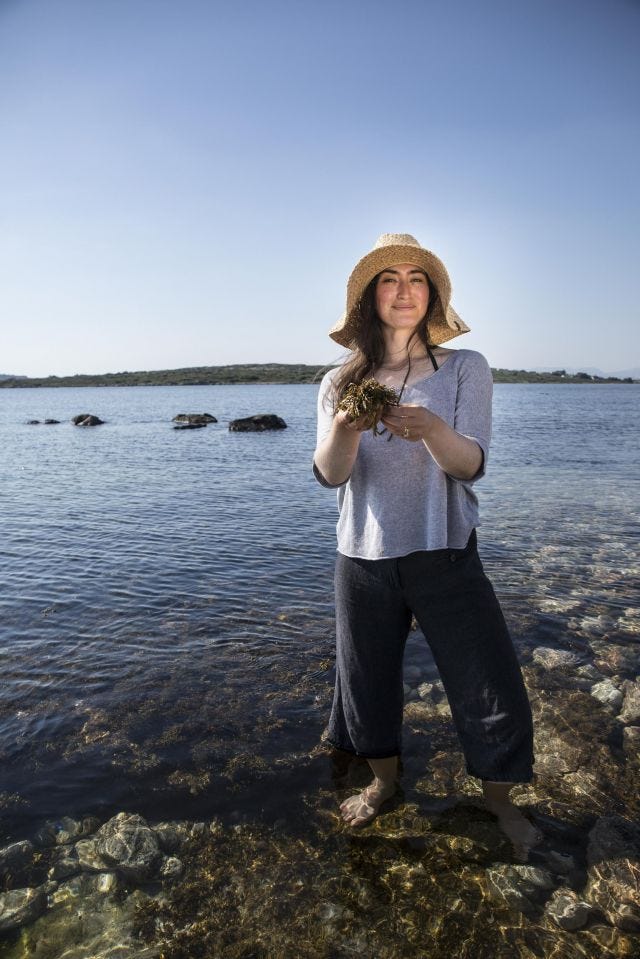
To close out the issue, it's time for "Three, Sixty", where we pose three questions on the theme of sustainability to an impact entrepreneur or innovator, to get a better understanding in sixty seconds of how they're working to achieve the SDG targets. For Issue 17, I'm delighted to welcome Sinead O'Brien, founder of Mungo Murphy's Seaweed, an aquaculture business based on the shores of Galway Bay, producing a range of seaweed-based products, and doing some ground-breaking work in the farming of abalone.
On a personal level, what impacts of the climate crisis are you most concerned about?
Personally, I am most concerned about the health of our oceans, not just because I work with seawater, but because once our oceans are dead, so are humans and most life on earth. Also, if I think about it for too long, I get very sad to think about how so many marine species have lived on this planet for hundreds of millions of years and how in such a tiny window, humanity has managed to threaten their continued existence.
Which of the UN SDGs did you start Mungo Murphy's Seaweed to address?
While I wasn’t actually thinking about the SDG at the time of creating Mungo Murphy’s Seaweed Co. my motivation was to promote and encourage sustainable consumption and production, so SDG 12.
How does your business model enable the transition to a low carbon, or more sustainable future?
I think food production is a really big area in which we need to reduce our carbon consumption and an area that also has in recent years contributed massively to the destruction of water ecosystems and biodiversity loss, through use of chemicals and fertilisers. Aquaculture can be a sustainable method of producing protein and sea vegetables especially as we enter a future where fresh water is a less plentiful resource.
We operate a land-based recirculating aquaculture system (RAS) to grow abalone (Haliotis discus hannai), a marine gastropod mollusc, a type of shellfish. This method of farming isn’t automatically low carbon as it is energy intensive, however we have a 20kw wind turbine installed to help power the majority of the farm’s electricity needs. For us, the benefit is that we don’t have to go out on boats to check on our animals and we are creating a renewable protein by growing the abalone ourselves from our own brood stock in our own hatchery. In addition, we have control over the water parameters which protects the health of the abalone. The abalone and the farm set-up are both very resilient which I think is of great importance for the sustainability of the farm.
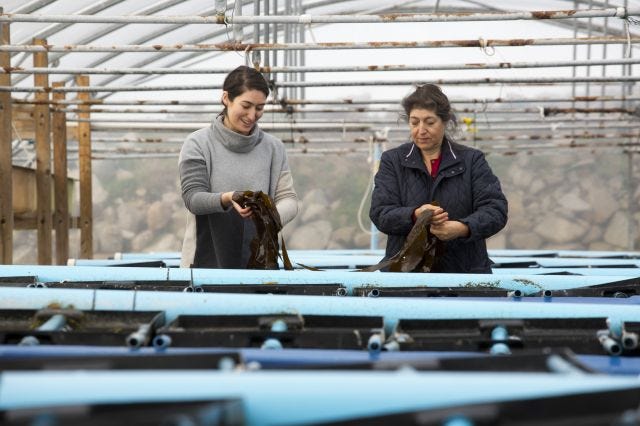
We now live in a world where the seawater is becoming more acidic and is warming alongside continued pollution from the land. These are major risk factors for marine life. Because we are working within a confined space and in a recirculating system, we can control the water quality of our tanks. If there happened to be a red tide or another dangerous algal bloom in the bay that feeds into our tanks, we can simply turn off the sea water pump and continue to recycle our water until the danger passes. As the ocean continues to dissolve excessive carbon dioxide emissions, the seawater is becoming increasingly acidic. This is already having a negative impact on shellfish in the wild. Again, the confined space enables us to ensure that the seawater in our system does not become acidic by adding calcium carbonate to the water. We plan on incorporating sea cucumber into the whole system as they naturally release calcium carbonate and also eat the abalone waste (digested seaweed) which in turn makes the sea cucumber even healthier as they benefit from the increased bioavailability of the pre-digested seaweed. We have not yet figured out the lifecycle of the sea cucumber but this is something we are investigating. We have achieved fertilisation of sea cucumber eggs and got the larvae to pre-settlement stage but have not yet figured out the settlement stage.
And, that's a wrap for Issue 17 of SDG Alpha! I hope you found it useful, and as always, if you did, please let us know, and don't forget to share! :)
Stay safe.
twitter | linkedin | resolve partners