Issue 99
Why Ireland’s climate transition needs less caution and more competition.

Good morning, friend.
Two pieces of research caught my eyes in the last fortnight, and prompted some thinking about where Europe, and Ireland specifically, currently stand in terms of climate innovation. First, the recent EIB Investment Survey painted a fascinating picture of European business confidence in the face of deep uncertainty. Eighty-six per cent of firms still plan to invest in 2025, even amid tariff turbulence, fragile geopolitics, and an uneven economic recovery. Beneath that headline resilience, though, lies a more telling split: 36% of firms see the climate transition primarily as a risk, while just 27% view it as an opportunity.
That imbalance says a lot about how European firms (Ireland included) are approaching the transition. We’re still framing decarbonisation as something to be managed, not necessarily leveraged. The survey’s language of “replacement investment” rather than expansion reinforces that instinct: capital flowing into efficiency upgrades, resilience measures, and compliance rather than growth bets on new green markets or regenerative business models.
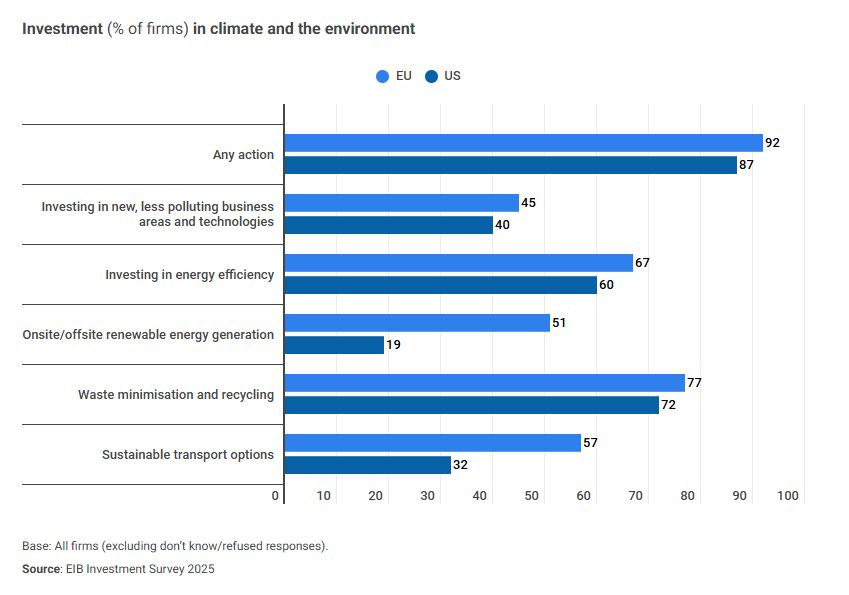
But climate risk and opportunity aren’t opposing ends of a spectrum; they’re interdependent. The firms most attuned to climate and ecological risk are often the ones already taking action — because the act of confronting fragility, whether in supply chains or ecosystems, is what opens the door to innovation. Irish companies that have invested early in circular processes, renewable self-generation, or low-carbon supply chains didn’t do so out of idealism; they did it because the economics started to make sense.
That’s where the Sightline Climate Globalisation in Climate Tech report (released earlier this week) adds another layer. It shows that the world’s most dynamic regions — from India to Latin America — are embracing climate and nature-positive technology not just to meet targets, but to deliver broader gains in quality of life, resilience, and economic security. Climate is not a constraint there; it’s a catalyst. Those regions are treating the transition as an industrial opportunity to be seized, not a regulatory burden to be endured.
Europe, for all its policy maturity and capital depth, still feels more cautious, and we don’t escape that characterisation here in Ireland. We have world-class innovators and access to European finance, yet the same barriers keep reappearing: planning delays on key enabling infrastructure projects, grid congestion, and slow market signals for demand-side innovation. The outcome is a quiet form of climate hesitation — an economy that’s grudgingly willing to adapt but not yet willing to compete.
If capital and technology are now moving faster than diplomacy, as the Sightline research would suggest, then the question for Ireland is not whether we can manage the transition, but whether we can profit from it. Can our firms see the climate and nature transition as something to grow from, not just something to defend against?
To get there, we’ll need the full ecosystem (investors, policymakers, and corporate leaders) to shift from risk mitigation to value creation. The opportunity is already here; the question is whether we’re ready to claim it.
Here’s the news round-up for Issue 99
Infrastructure + Energy
Ireland’s new Scheduling and Dispatch Programme marks a major reform to the electricity market, allowing batteries to trade directly across wholesale, intraday, and balancing markets for the first time. The move boosts investor confidence, enhances grid flexibility, and could increase battery revenues by up to 37%, supporting Ireland’s 80% renewable electricity target for 2030.
RES has lodged plans for a new Battery Energy Storage System near Larne, designed to strengthen grid stability and support renewable generation while minimising visual and environmental impact. The Ballyross project includes native planting, wildflower corridors, and landscaping shaped by community feedback, with construction expected to take around 20 months if approved in 2026.
Carlow County Council has granted conditional planning permission for a 57-hectare solar farm spanning seven townlands, proposed by Ballyloo Solar Farm Limited. The project includes panels, inverter stations, weather sensors, and underground cabling, with a 40-year operational plan but only a 10-year approval window. Thirty-five conditions apply, including site removal if operations cease for more than a year.
Belfast Harbour has secured a £100 million deal to assemble turbine components for two major Irish Sea wind farms, creating around 300 jobs and positioning the port as a key hub in the offshore energy supply chain. The Mona and Morgan projects, led by EnBW and JERA Nex bp, will generate up to 3 GW of clean power—enough for three million homes—while supporting a new £90 million dual-purpose cruise and wind terminal due by 2027.
The Department of Climate, Energy and the Environment has launched a €5 million pre-construction fund to accelerate Ireland’s district heating rollout, supporting early-stage projects as part of the Climate Action Plan. Managed through SEAI, the fund aims to bridge the financing gap before larger capital commitments arrive, helping public and private sponsors bring efficient, low-carbon heat networks to shovel-ready stage. Expressions of interest are open until 12 December 2025.
ESB Networks will invest €6.5 million in its Portlaoise National Training Centre to expand Ireland’s renewable-ready workforce, supporting 156 new electrical apprentices and 120 additional recruits in 2026. The move underpins ESB’s €13.4 billion capital plan to build a net-zero-ready grid by 2040 and strengthen skills at the heart of the energy transition.
Finance + M&A
Moby Bikes, Ireland’s first e-bike sharing scheme, has returned to Spark Crowdfunding to raise €500K as it pivots from fleet operations towards a fintech-style SaaS model. EIIS-eligible and already profitable, Moby is positioning itself for rapid European expansion and potential consolidation in a €100Bn market.
Dublin-based CEL Critical Power has opened its first US manufacturing plant in Virginia as part of a $40 million investment that will create up to 500 jobs by 2030. The facility boosts CEL’s global capacity to over half a million square feet as it scales power systems designed for next-generation AI and cloud infrastructure, underscoring Ireland’s growing role in the global data and energy technology value chain.
US manufacturing giant Jabil has agreed to acquire Ireland’s Hanley Energy Group for $725 million, with an additional $58 million contingent on future revenue growth. The deal strengthens Jabil’s position in the fast-growing data centre infrastructure market, combining Hanley’s critical power and energy management expertise with Jabil’s global engineering and manufacturing capabilities. The acquisition is expected to close in early 2026, pending regulatory approvals.
Bank of Ireland has raised €750 million in its second green bond of 2025, following strong investor demand that saw over €2.6 billion in orders from 140 global investors. The ten-year bond, priced at 3.625%, will fund renewable energy, energy-efficient buildings, and sustainability-linked loans, helping the bank exceed its €15 billion sustainable finance target ahead of schedule. It now aims to reach €30 billion by 2030 as part of its broader climate action strategy.
Cork-based Simply Blue Group has secured a major strategic investment from Japan’s Kansai Electric, which takes a majority stake in its offshore wind development arm to accelerate expansion across Ireland and Europe. The deal signals Japan’s growing role in European renewables and could advance Simply Blue’s 12GW wind pipeline—though CEO Hugh Kelly warns progress still hinges on faster government delivery.
Policy + Regulation
Ireland’s new Biomethane Environmental Sustainability Charter sets out 17 commitments and 8 recommendations to guide the agri-led roll-out of anaerobic digestion (AD), highlighting its potential to improve water quality and ease pressure on the nitrate derogation. The charter reinforces the government’s 2030 target of 5.7TWh of home-produced biomethane, and points to AD’s role in reducing fertiliser use, managing slurry, and supporting farm income diversification.
Innovation + Technology
The Green Ocean Foundation has expanded its Dublin Bay Oyster Revival Project, adding new marine baskets at Dún Laoghaire Marina to build on early success restoring native oyster reefs. With mortality rates below 3% and evidence of spat settlement, the initiative is showing promise for biodiversity recovery, carbon sequestration, and coastal protection. Supported by UCD, Trinity, and local yacht clubs, the project is now scaling its impact across the bay. (I interviewed the project funder, David Lawlor of Watermark Coffee, back in Issue 80 - see below!).
Full Stack Energy, a Limerick-based clean energy technology company, is expanding into the US through a partnership with Massachusetts consultancy Skipping Stone. The collaboration will combine both firms’ expertise to deliver flexible, data-driven solutions for utilities and energy service providers tackling challenges in decarbonisation and distributed energy.
Two Irish research projects, HERO and BUSUnited, have secured almost €3.5 million from the EU’s Life Programme to tackle skills shortages and boost Ireland’s home energy retrofit capacity. HERO aims to double the rate of deep renovations through improved One-Stop Shop models, while BUSUnited will reskill and connect over 400 stakeholders across Europe’s construction sector. Together, they target key bottlenecks in Ireland’s path to 500,000 home retrofits by 2030.
Some audience participation required next: a new survey led by an ATU-based researcher aims to assess how well manufacturing firms are developing the dynamic decision-making capabilities needed to embed circular economy principles in their operations. The findings will inform a practical tool to help businesses advance from awareness to implementation across reuse, repair, and recycling practices.
NovaUCD-based Proveye has secured European Space Agency support to launch its AI-driven agritech tool, ProvVari, which uses satellite and drone data to optimise fertiliser use and protect water quality. Expected to debut in Ireland in early 2026, the platform builds on the company’s remote sensing expertise to align farm productivity with environmental and biodiversity goals.
There’s a nice feature in The Irish Times of Louth-based start-up Bionua (one of our fabulous Accelerate Green alumni 😍), who have developed an affordable, real-time soil health sensor that could transform how landowners and corporates monitor biodiversity and carbon capture. Founder William Butterly’s “bury-and-forget” device aims to make soil data accessible to farmers while powering high-integrity, locally verified rewilding and carbon credit projects. Field trials (no, really) are under way, with plans to manufacture in Ireland and expand into Europe next year.
Events + Community
The RDS Circular Economy Programme, run in partnership with Trinity Executive Education, recognises Irish innovators embedding circular design and resource efficiency into their businesses. With applications open until December 6th, the 2025 Awards spotlight emerging, SME, and new social enterprise leaders reshaping production and consumption through circular principles. Winners receive cash prizes and a scholarship to a Trinity short course supporting continued learning and innovation.
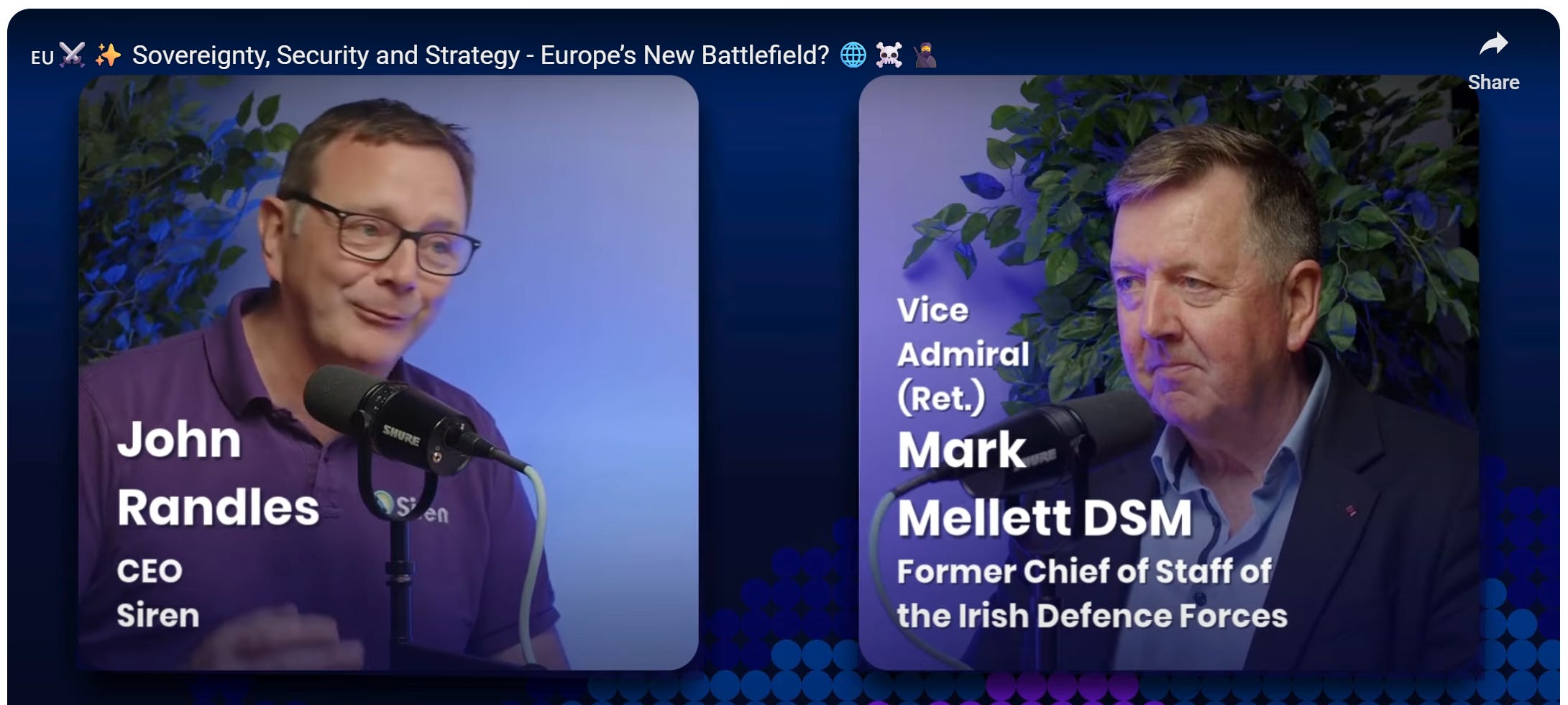
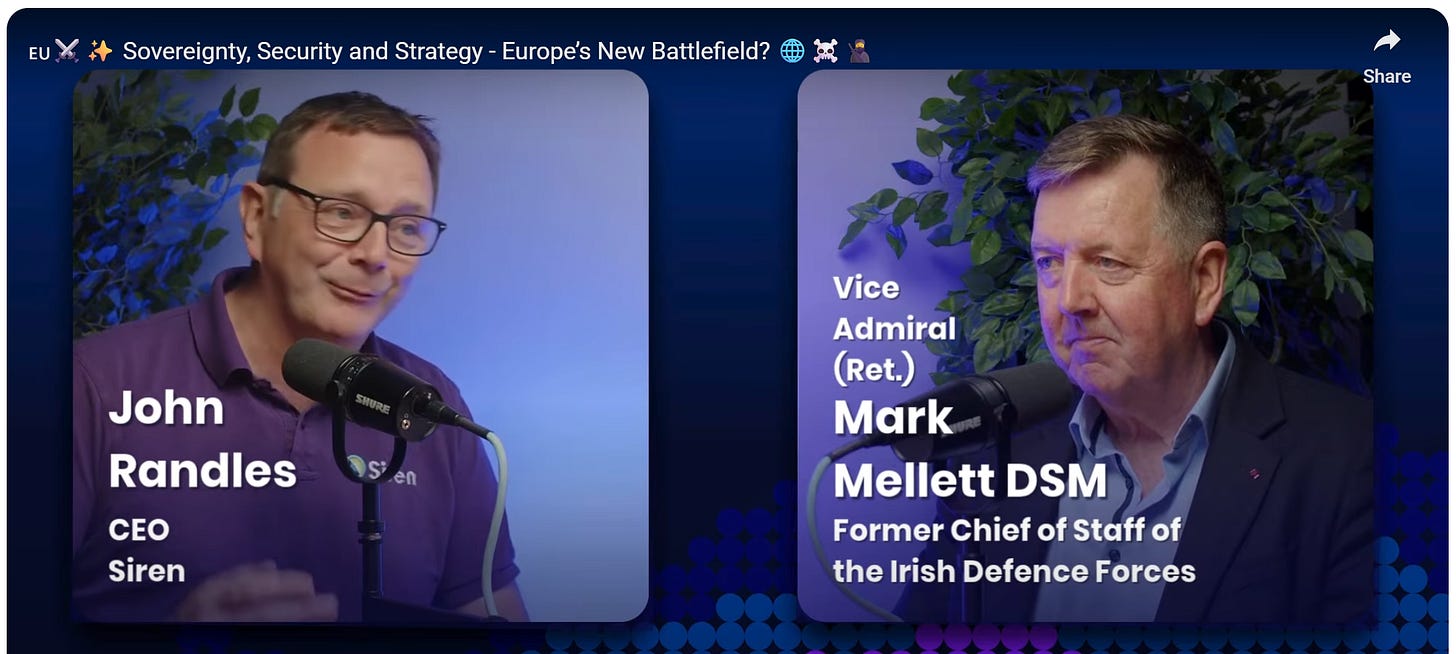
A successful energy transition depends on shared infrastructure — and that means shared security and responsibility. In a recent episode of the Siren Investigates podcast, John Randles speaks with Vice Admiral (Rtd) Mark Mellett, former Chief of Staff of Ireland’s Defence Forces, about how Europe must rethink sovereignty, security, and resilience in an era of hybrid threats. Mellett argues that sovereignty is like property: “you only own it if you can defend it” warning that peace-time complacency has left many nations exposed. Their discussion ranges from cyberattacks and disinformation to AI, innovation, and the need for European strategic autonomy that blends defence, diplomacy, and decarbonisation. Ireland’s maritime domain, he notes, is both a vulnerability and an opportunity — a frontier where energy, data, and food security intersect. It’s a powerful reminder that collective security isn’t just about armies and alliances, but about how we protect the systems and values that power our shared future.
The National Retrofitting Conference returns to Dublin’s Talbot Hotel Stillorgan on Tuesday, 25 November 2025, bringing together policymakers, energy suppliers, and construction leaders to assess progress toward Ireland’s target of upgrading 500,000 homes to B2 energy ratings by 2030. With sessions spanning heat pump adoption, skills gaps, and supply chain development, the €275 (plus VAT) event offers a comprehensive look at the challenges and opportunities in scaling national retrofit delivery.
Bioregioning South East Ireland will host its Bioregional Gathering 2025 at Lismore Heritage Centre on November 26th, inviting local changemakers to co-design the region’s next phase of sustainable transformation. The day will explore lessons from 2025 initiatives like holistic farming, bioregional finance, and Ireland’s first Bioregional Basic Income, while afternoon “blossom” circles will map out new infrastructures and collective actions for 2026. Contributors include John Murphy, Ray McGrath, Roger Ahern, and Siobhán Hubbard.
The Dublin Climate Dinner returns on November 21 at Cornucopia on Wicklow Street — a relaxed monthly meetup for anyone working in or curious about climate, sustainability, or social justice. Founded in 2023, it’s a community-building evening over good food and conversation, welcoming newcomers and regulars alike. A small donation helps reserve the table and support the venue.
November 18! Why on earth is it stuffed with SO MANY EVENTS? First, Climate Cocktail Club returns with Fashion Faux Pas — a night blending sustainability, style, and storytelling. Hosted by Fionnuala Moran, the event features Troy Armour of Junk Kouture (who featured in another interview from WAY back in Issue 10!) and a host of other guests exploring youth leadership, circular fashion, and sustainable production.
Next, Energy Innovators Ireland hosts its next meetup on November 18th at Neary’s, Dublin 2, featuring Simon Leonard of EDF Power Solutions. Leonard, host of The Irish Energy Update podcast and RE Awards nominee, will discuss “Liebrich and Gates – The Final 10%,” exploring the frontier of clean energy innovation and sustainable growth.
Finally on 18 November, Trinity Business School will host a strong-looking panel exploring Ireland’s path to an 80% renewable power grid by 2030, highlighting the technologies, infrastructure, and policies needed to ensure both sustainability and security. Folks, I’m going to attempt the truly heroic feat of attending all three of these events on Tuesday - wish me luck!
And, to close, a very welcome piece of positivity: the NPWS has purchased 208 hectares of land to expand Glenveagh National Park in Donegal, an area roughly the size of Monaco. The acquisition increases the total area of Ireland’s national parks to over 98,000 hectares and protects habitats supporting rare species such as golden plovers, peregrine falcons, and alpine mosses. Worth taking a moment to savour this one 💚